


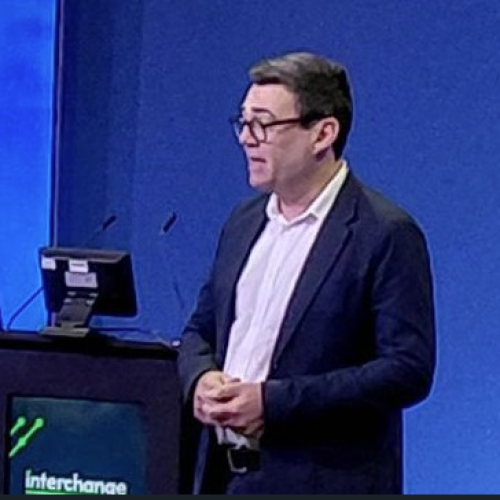
“Mayors spend a lot of time talking about transport,” according to Dave Skaith, Mayor of York and North Yorkshire, “Because transport unlocks everything.” Skaith’s point, made during Interchange 26, was illuminated by fellow combined authority mayors throughout the event.
During the West of England Combined Authority’s Kids Go Free initiative, the number of children taking the bus doubled in areas where families have incomes among the lowest 10 per cent in the country, according to Mayor Helen Godwin. Active travel programmes in Greater Manchester Combined Authority’s region are saving the equivalent of over one million GP appointments.
Research for the West Midlands Combined Authority found a strong correlation between the communities with the poorest life outcomes and accessibility to poor transport infrastructure. Similarly, Skaith’s region is geographically large, with a low population density. Transformative regional transport will, he envisages, “make the region feel smaller” and enable improved connectivity between communities which fosters improved economic outputs.
So England’s combined authority mayors see transport as an engine of societal advance as much as a driver of commerce, often presenting the two as interlinked.
Unlocking housing
Creating new housing is a major part of mayoral agendas. “Devolution has put transport at the heart of placemaking,” Manchester Mayor Andy Burnham noted during his keynote Interchange 26 address. His vision for ‘liveability’ is to develop “homes for public transport, not homes for cars.”
With the ability to influence both housing and transport within their regions mayors are in a very strong position to ensure that the transport infrastructure necessary to support new homes is planned from a regional perspective and accounted for during housing programmes’ formative stages. Something “mayors are in a unique position to co-ordinate,” according to Liverpool City Region Combined Authority Mayor, Steve Rotherham.
Aligned to the idea of homes for public transport – and a thing mayors and representatives from adjacent bodies at Interchange referenced – is the wish to, in the words of Sandeep Shingadia, Director of Development and Delivery at Transport for West Midlands “Make public transport the mode of choice, not last resort.”
Modally agnostic strategies
Combined authority regions a not homogenous, as a consequence, neither are the routes to achieving the aspiration to increase the use of public transport. Some common threads, however, were in evidence at Interchange. ‘Multi-modal’ strategies that bring sustainable travel modes such as cycling together with surface transport systems on the road and rail networks, provide greatest flexibility, so the key is to ensure that these different modes are physically and temporally aligned. The physical network needs to be supported by an easy-to-understand and operate ticketing structure. Branding should be clear and readily identifiable. All of these steps contribute to the goal of seamless-pan-regional travel, able to support, in Shingaia’s words, “the journeys of everyone.”
Accessibility is another element necessary to broadening the use of pub lic transport. Passengers with mobility and other special requirements need to have confidence in end-to-end accessibility, that they are able to complete their entire journey and not find step-free access, for instance is fragmented. For new infrastructure, Mayor Rotherham suggested, accessibility need not increase cost significantly if it is incorporated early in the planning phase.
Promoting public transport and offering a genuinely attractive alternative to car travel is part of many combined authorities’ strategies to reduce the greenhouse gas emissions driving climate change. In addition transport networks that enable active travel, integrated cycle and walking routes for instance, were cited as public health benefactors and provide access to alternative commercial and leisure facilities to bespoke out-of-town retail parks – a critical component in reviving local high streets and their surrounding communities. A further factor is substantial growth in the number of young adults who do not own cars.
Delivery insights
The long-term funding horizon facilitated by the devolved Integrated Transport Settlements is key to delivering the goals discussed by the mayors at Interchange. To help achieve the best outcomes from their investments, Octavius has seen that combined authorities ascribe value to the insights the transport infrastructure supply chain can offer, especially with regard to which contracting and procurement strategies best align with the mayors’ goals.
Among the attributes we believe are best aligned to the delivery of transport infrastructure that fulfils combined authorities’ goals are:
- Demonstrable experience of working successfully under progressive contracting arrangements
- Expertise in all facets of transport infrastructure and multi-modal integration
- Peerless experience in integrating and aligning diverse stakeholders’ competing priorities
- Alignment with combined authorities’ social, environmental and accessibility priorities
We hope you found this helpful, here is some more information you might find valuable:
- Social value champion: How to embed social value creation
- Harmonising delivery: The importance of the integrator
- Multi-modal projects need multi-disciplinary leaders
- Local heroes: Why a caring contractor is essential