


Diverse stakeholders are a hallmark of the transformative projects many combined authorities are looking to implement, so a delivery partner able to integrate and align competing priorities with project goals is key to success.
A complex matrix of network users, stakeholder agencies and suppliers is often a defining feature of combined authority transport infrastructure projects. This can apply across the spectrum from mass transit programmes through to enhancements in local transport infrastructure, on schemes that frequently encompass multiple modes of transport.
Successfully managing this complexity requires a delivery partner with the proven ability to integrate the multiple groups’, often conflicting, requirements; and ensure alignment to achieve the collective outcomes which support the combined authority’s regional and inter-regional objectives.
Octavius has developed substantial experience of undertaking the integrator role – the organisation that co-ordinates planning, oversees design and ensures the efficient completion of safe, sustainable construction.
Unifying objectives
The regeneration of March town centre demonstrates this. Octavius’ primary client interface was with Cambridgeshire County Council (CCC). But as is common with regional devolution, the project was closely supported by a number of stakeholder partners, with funding from multiple streams: The Future High Street Fund, under the auspices of Fenland District Council, funded the pedestrian areas; carriageway investments came under CCC’s March Area Transport Study; Cambridgeshire & Peterborough Combined Authority provided additional funding and oversight. Phasing for the project was linked to separate funding streams which also needed to be captured and reported individually.
A further example of our teams managing complex stakeholder ownership is the A38 Major Road Network (MRN) Improvement Scheme, awarded by North Somerset Council. With funding drawn from two streams – Department of Transport and Bristol Airport – successful delivery required Octavius to develop and manage two separate cost plans and implement dual financial handling regimes.
Across both March and A38 MRN, integrating supply chain partners was as fundamental to achieving project goals as the ability to manage multiple stakeholders.
Integration enables accessibility
Effectively integrating the needs of multiple stakeholders is central to Octavius successful delivery of accessibility projects under Network Rail’s Access for All (AfA) programme.
Accessibility enhancements at Barnes Station typifies this. The project scope followed a standard AfA footprint comprising two footbridges, three lifts and three staircases. As well as the client, Network Rail, and train operating company South Western Railway, the delivery team also collaborated extensively with the local authority as well as local residents and businesses in the immediate vicinity of this suburban station in southwest London.
Understanding the needs and aspirations of other influential neighbours such as the London Wetlands Centre, and Barnes Common was also vital to the successful completion of the project. As with the March and A38 MRN projects, programme and supply chain integration was a key element of successful project delivery at Barnes. Managing this level of complexity, by integrating and aligning multiple stakeholders’ and supply chain partners priorities with the project’s goals, has been common across Octavius’ portfolio of more than 35 AfA projects nationwide.
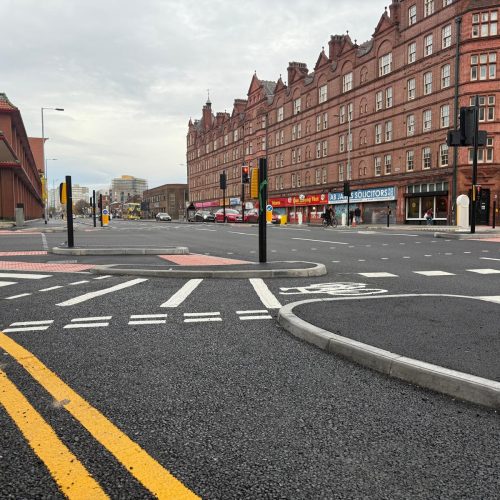
Aligning multiple stakeholders needs alongside integrating multiple modes of transport lies at the heart of the Victoria North East Gateway project in Manchester. The scheme is a package of road, cycle and walking route enhancements that improve access to Manchester city centre and mass transit networks; and provide connections to walking and cycling schemes in other parts of the city.
Octavius is Manchester City Council’s principal contractor for the project, under Manchester City Council Highways Construction Works Framework. The scheme is among the larger infrastructure elements of Manchester’s Bee Network, Mayor Andy Burnhmam’s programme to provide the city with a joined up, locally controlled transport network.
The scope includes:
- Reconfigure four routes
- New footways and traffic islands
- New controlled pedestrian crossings
- New CYCLOPS (Cycle Optimised Protected Signals) cycle and pedestrian junctions
- New segregated cycleways
- Relocated bus stops
The reconfiguration work runs across four main thoroughfares that host a thriving mix of homes and businesses; and are the site of several live commercial and residential property developments. Elements of the route pass through a conservation area, whilst one of the sites is also home to the Manchester Central Community Fire Station. As such, the list of stakeholders and agencies whose needs are to be integrated into the project is diverse and complex.
Supporting new stations
 Okehampton Interchange is the most recent addition to the Octavius portfolio of multi-modal transport hubs. Located on the Dartmoor Line, this new purpose-built interchange is a fundamental component of the region’s growth strategy, which sits in close proximity to the A30 so provides alternative access to the town centre – thus reducing traffic and relieving pressure on existing parking facilities.
As well as creating a step-free access single platform the Okehampton Interchange project integrates the rail line with pedestrian and cyclist networks – which will be improved as part of the scheme. In addition, new infrastructure will integrate several local bus routes into the interchange. The scope also encompasses sheltered parking space for bikes and 200 new car parking spaces, including electric vehicle charging points. Which all adds up to improved travel choices and contributes to regional low-carbon travel strategies.
The project typifies a new generation of multi-modal interchanges being created across the country as previously disused railway lines are re-opened as a means of transforming regional transport infrastructure.
Multiple agency funding is another thing Okehampton shares with many new regional rail station projects. The £15 million cost is split across the Department for Transport, Devon County Council, West Devon Borough Council and Network Rail.
Integrating Project 13 experience
Project 13 is a progressive enterprise delivery model that seeks to remove traditional segmented client and supply chain relationships and reform those parties into a single integrated enterprise to deliver the asset owner’s projects or programmes. Collectively, the enterprise’s constituent organisations are better able to innovate, saving time, cost and waste. The aim is to create trusted business-to-business relationships focussed on win:win outcomes. Project 13 has been championed by, among others, the Institution of Civil Engineers and National Infrastructure Commission.
The Southern Renewals Enterprise (SRE), responsible for renewals across Network Rail’s Southern Region, is the first UK use of the Project 13 model to undertake railway renewals. SRE is a £9 billion, 10-yr programme serving the most congested areas of the UK’s rail network. Octavius is the SREs’ Electrification and Plant (E&P) partner.
With the Project 13 approach becoming more widely adopted across the infrastructure market, our delivery experience under this model is proliferating across Octavius, strengthening our ability to fulfil the role of the Integrator by managing complexity through the alignment of multiple delivery partners and stakeholders.
We hope you found this helpful, here is some more information you might find valuable:
- Electrification in the age of enterprise delivery
- Will Somerset’s new approach to highways contracts catch on?
- Collaborative working comes to the forefront
- Frameworks: Embedding repeatable social value success