

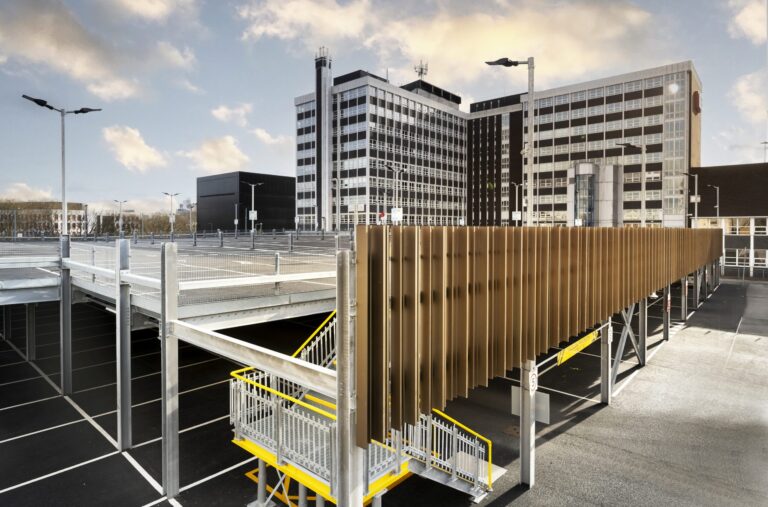
What we delivered
The Octavius and SiderPark modular system delivered a fast, flexible, and cost-effective solution for the University of Salford, transforming an underused area into 462 parking spaces, nearly doubling existing capacity. Around 30% cheaper than traditional pre-cast concrete construction, the system enabled the university to increase parking provision quickly and with minimal disruption.
Highly adaptable, the car park can be expanded, dismantled, or even relocated to meet future needs. A key advantage of the modular approach was its flexibility during construction. The first deck opened in November 2025, ahead of full completion in
December 2025, allowing the university to use the facility while work continued safely above.
The need
The University of Salford is undergoing a period of significant growth as part of its Campus Connectivity Plan. However, as land previously
used for parking is repurposed the need to provide additional parking became critical. The solution needed to be delivered quickly and
efficiently, without disrupting ongoing construction or day-to-day campus activity. Sustainability was also central to the project, with
both the university and Octavius committed to delivering a low-carbon solution. A modular car park provided the ideal solution—meeting all of these needs.
Key features
- 462 total car parking spaces, increasing capacity by over 200 spaces through the installation of a modular parking system. This includes 309 ground-floor spaces and 153 first-floor spaces, with the flexibility to install a second deck.
- 47 electric vehicle (EV) charging bays to support future provisions.
- Re-lined the 36 existing accessible (disabled) parking bays.
- Upgraded CCTV coverage and installed energy efficient lighting.
Early Contractor Involvement
Octavius in collaboration with SiderPark, began Early Contractor Involvement (ECI) with University in December 2024. During ECI, the team undertook surveys and ground investigations, supported the price build, and aided the client with the planning application.
Site surveys identified a need for piling. The team explored options that could reduce costs while supporting an accelerated programme. The solution was Keller, a provider of rigid inclusions, which offered a cost-effective alternative to traditional piling methods and
helped speed up construction. The university is adjacent to Network Rail infrastructure, this required completion of
Network Rail’s temporary works design approval process. Due to Octavius’ railway expertise, this was completed in four weeks instead of the
average 12 weeks.
By combining rigid inclusions with a Sustainable Drainage System (SuDS) -based dual-purpose
piling mat, the project delivered environmental, cost, and programme enhancements:
✓ Material savings: 300m³ / 700 tonnes of stone reused on site.
✓ Reduced transport: 70 fewer lorry movements, lowering fuel use, traffic, and carbon emissions.
✓ Cost efficiency: £86k spent on rigid inclusions
versus £140k for traditional piling leading to approx. 40% cost savings.
✓ Programme acceleration: Piling completed in 3 weeks compared to 6 weeks for traditional methods: 50% faster delivery.
Sustainable Drainage System
A key feature of the project was the Sustainable Drainage System (SuDS), required to manage surface water and prevent local drainage
networks from becoming overwhelmed. Rather than installing a separate attenuation tank, the team designed the piling mat to serve a dual
purpose as a stone-filled attenuation tank. The piling mat, constructed to a depth of 600mm and built using large single-sized stone, created
natural voids that allow rainwater to be temporarily stored beneath the car park before being released slowly into the drainage network
through a Hydrobrake flow control device. This approach meant the piling mat both supported the structure and provided effective
water attenuation. The solution delivered three to four times more storage capacity than legally required, while reducing excavation, materials, transport movements, and carbon compared with traditional drainage solutions.
Rigid Inclusions
The project marked the first time Octavius and Siderpark modular car park solutions used rigid inclusions to support the structure.
To overcome challenging ground conditions, rigid inclusions were used to create a strong and stable foundation for the modular car park, avoiding the need for more complex and material-intensive traditional piling. This approach reduced ground movement, improved buildability, and supported a faster, more efficient installation.
Social Value
Octavius is committed to supporting the local community delivering social value, in total £731,111 of social value was added whilst
delivering the project.
- £562,638 social value achieved from spending with local small & medium enterprises
- £167,500 social value achieved from spending with larger local suppliers
- 97.5 hours of health, safety and wellbeing training delivered to project employees.
- Supported a five-week work placement with student from the University of Southampton.