

At the leading edge of progressive procurement are organisations adopting enterprise delivery or Project 13 principles. But many projects, while not implementing full-blown enterprise delivery/Project 13 methods, are delivering in an ‘enterprise adjacent’ manner.
Achieving the A46 Walsgrave junction Development Consent Order (DCO) is a great example. The final arbiter of a DCO is the relevant secretary of state, if they reach this stage most submissions are granted. Getting to this stage, however, is protracted and challenging. Success, for Walsgrave, was rooted in integrated working across all parties – creating almost a virtual enterprise.
“You need to make sure all the teams are aligned within an organisation as well as all the organisations,” observed Senior Project Manager Anne-Marie Cobb, an approach straight out of the enterprise delivery playbook.
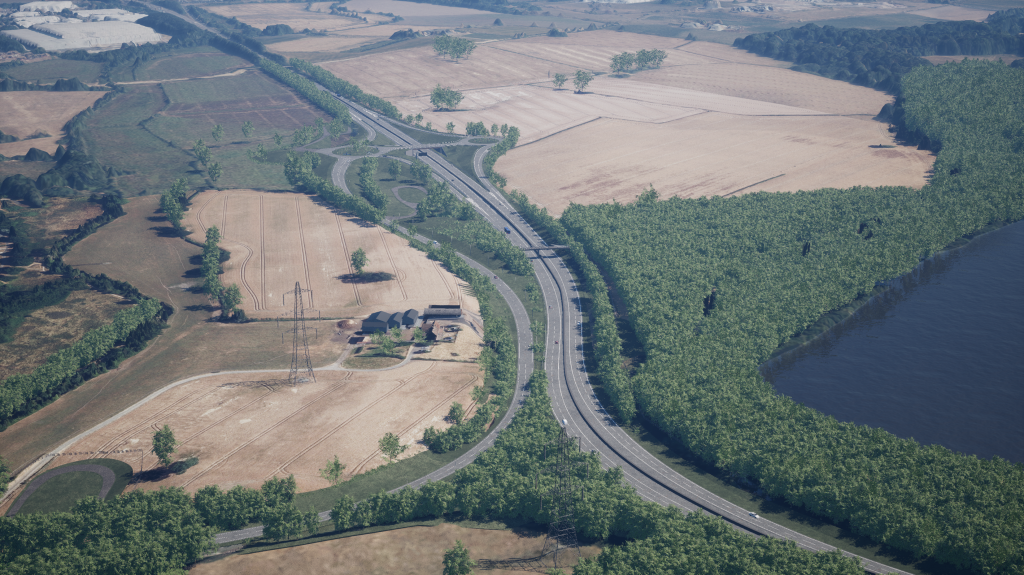
A46 Walsgrave junction is the second element of National Highways enhancement of the A46 ‘Trans-Midlands Trade Corridor’ between the M5 and the Humber Ports. Enhancing the junction is a £112.5 million Nationally Significant Infrastructure Project with Octavius appointed as principal contractor.
The other partners of the DCO project were the client National Highways; a design joint venture (DJV) comprising Sweco and Cowi; the client’s legal representatives and the designer’s DCO specialists.
Delivering digital transformation
Digital Transformation is one of the key pillars of the Project 13 model for enterprise delivery. Creating a common data environment accessible to all partners is an important step in digital transformation. For work in progress the Walsgrave team partners used the designer’s common data environment, because it was BIM compliant. Documents were also hosted on Octavius’ SharePoint site, which was made accessible to everyone on the project. Everyone was working on the same documents, often at the same time.
Commonality and efficiency were enhanced by appointing a single document controller working across all partners. In addition to the common data spaces, the document controller had access to areas of partners’ systems relevant to the project such as National Highways’ Business Collaborator tool.
Creating an enterprise culture
Digital transformation is only possible if an environment of trust and collaboration is fostered, which is also fundamental to creating an enterprise culture. At Walsgrave this was manifest by making ‘best for project’ decision making the touchstone.
From day one the partners tried to work as one team and identify who was best suited to deliver a particular activity, rather than sticking to conventional roles. For example, Octavius, as delivery integration partner was initially expected to own the programme. Review showed, however, that circa 80 per cent of the activities were being carried out by the designers. So it was agreed that the designers would own the programme.
The partners’ response to a missed deliverable was a further manifestation of best for project decision making. Although the reason for a problem was addressed, the primary focus was to collectively see what was necessary to get things back on track. It was not necessarily the owner of the deliverable who was tasked with remediation but rather how, as a team, could the partners work together to get the matter resolved – often regardless of who it sat with contractually. “What we focused on more was how do we move on from here to make sure we’re still going to keep the goal that we’re all aiming for,” according to Cobb.
With resolution the immediate focus, analysis of why things did not go as planned was typically undertaken in a blame free manner, not in the heat of the moment but in analytical formal lessons learned workshops held every three months. There were difficult conversations, and sometimes disagreements, but it was how they were handled that was important.
Collaborating for success
And the approach was a success. The Secretary of State for Transport Heidi Alexander granted Walsgrave consent in February 2026. The manner in which this was achieved is testament to the collaborative way in which the team worked and the focus on best for project decision making. Three sets of hearings were anticipated, in the end only one was necessary. The planning inspector review period was reduced. The Secretary of State review period was reduced, the examination period was reduced.
The last word on this goes to Anne-Marie Cobb, “We had really tight time frames, but I think because everybody was pulling in the same direction, we were able to put in a really strong submission because we weren’t spending time arguing about stuff that wasn’t relevant. We were all focusing on ‘this is the common goal, how do we get there?’” And this approach is being extended into the project’s delivery phase.
As principal delivery partner in the UK’s first enterprise delivery programme for railway renewals or as the principal contractor for an enterprise adjacent approach like the one adopted to achieve DCO for the A46 Walsgrave enhancements, collaborative working and a focus on best for project decision making is at the heart of the way Octavius works.
Here are more Infrastructure Enterprise Delivery resources you might find valuable:
Talk to us
Contact us at transformative@octavius.co.uk if you want to know more about the ways Octavius is enabling infrastructure enterprise delivery